Mockingbird Hill Cottage

Mockingbird Hill Cottage

  • About MHC
    • Disclosure
  • Dollhouses/Minis
    • Hummingbird Cottage
    • The Studio (Formerly TSP)
    • Dove Cottage
    • The Lake House
    • The Folk Art Dollhouse
    • The Modern Dollhouse
    • The Beacon Hill Dollhouse
    • Dollhouse Source List, Information and Tutorials
  • On the Road
  • Collecting
    • Roseville Pottery
    • McCoy Pottery
    • Egg Cups
    • Bakelite
  • Press
  • Privacy Policy

The Rehearsal Process: Working One-On-One and Blocking

April 24, 2013 at 8:59 am by Claudia

quiltsun

There’s something awfully comforting about seeing this quilt on the hotel room bed. Even better: being tucked under it at night. Duvet, schmuvet….I like my quilt.

My word, it was cold yesterday! Windy, cold, and more like the beginning of March than the end of April. Since I brought only a jean jacket with me – no hat, no gloves – to say I was uncomfortable is putting it mildly. This is the strangest spring I can remember. Today, however, promises to be warmer and I’m counting on that. I want spring, thank you very much.

After writing yesterday’s post and spending 4 hours at rehearsal, I called Don on a break. He informed me that I had a typo in the post: I had typed Sunday instead of sunny. Oy. I find it amazing that I can type a post, proofread it more than once, and still miss an error. Alas, I couldn’t fix it until I got back to the hotel. Those pesky typos drive me crazy, slightly reformed perfectionist that I am.

We finished our table work yesterday and now we move on to a schedule that has me in and out of rehearsal throughout the day. The other day, I mentioned the one-on-one work I do with actors. I started those sessions on Sunday and will be doing more today. What is one-on-one work? Well, it can be several things. Right now, it’s a chance for me to meet with individual actors, get to know them a bit, and to go through their lines together. I point out pronunciations and words that need to be stressed within the framework of iambic pentameter. What is iambic pentameter? It’s the meter in which Shakespeare (and others) wrote. It measures the number of syllables in a line of text which fall into a natural rhythm. An iamb is two syllables or beats, consisting of an unstressed syllable and a stressed syllable. Pentameter refers to the fact that there are 5 iambs in a line or ten beats.

Example: “If music be the food of love play on.” (The first line in the play, spoken by Orsino.)

Using iambic pentameter as our guide, and starting with an unstressed syllable, we get:

If MUsic BE the FOOD of LOVE play ON.  (da DUM da DUM da DUM da DUM da DUM.)

Shakespeare was brilliant. By using iambic pentameter, he gave all the clues an actor needs to find the meaning in a line of text and the way it should be expressed. It’s also been said that an iamb mimics our own heartbeat. There is a natural quality to speaking this way. Though to a newcomer it might seem constricting, actually it’s freeing once you get it. The challenge for the actor is to take this structure, this meter, and speak it in a way that isn’t sing-songy, but is heightened and natural at the same time.

In the poetic sections of text (Shakespeare also wrote in prose) there are usually 10 beats to a line. Sometimes, there are 11. Occasionally, 12.  Sometimes the normal rhythm of an iamb is changed to a trochee where the stress is on the first syllable and the second syllable is unstressed. Or a spondee: two stressed syllables in a row, followed by two unstressed syllables. Iambic pentameter is by far the most prevalent metrical stress used in Shakespeare and when it varies it always gives a clue as to what is happening in the scene and what heightened emotions or changes the character is going through.

This all sounds highly technical, but once an actor learns the art of scansion, which is going through each line of the text and marking the stresses, he has the framework in place to begin his interpretation of the character he is playing.

I spend time with the actor on just that in the first individual sessions. And if there is a line of text that doesn’t easily fall into 10 syllables, 5 beats, we work at it like detectives and try to figure out just what Shakespeare wanted in that line. I also point out words that need to be heightened in the way they are uttered because our contemporary way of speaking words can creep in and that’s a no no. This is elevated text.

That, in a nutshell, is what we do in our first session together. As we move further into the rehearsal process, we tackle the voice, breath, how to handle long, complicated thoughts on one breath, speaking clearly and fully. If I or the director notice something that needs to be addressed, I schedule a session with the actor. But there will be more on that later.

While I’m working individually, the director is beginning the process of blocking the play. Blocking = the positions and movements of the characters in a scene. Every director does this differently. Some chart it in detail before the rehearsal, others have a general idea of what they want and make decisions during the rehearsal itself. Many rely on the actors’ instincts, as well. It can be a very collaborative process. In this particular production, the set is a complicated labyrinth of boxwood hedges, as in a formal garden. The actors will be in and out of the maze, appearing, disappearing, and even walking on top of the hedges. So the blocking is even more complicated than normal. But Darko, the director, is brilliant at that sort of thing. He loves the challenge and his background is in movement, so he sees things as a sort of dance. This is going to be an amazing visual treat.

Whew! I hope this wasn’t too much information. It’s a challenge to put into words a process I know like the back of my hand.

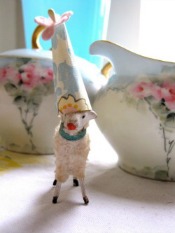
Oh, I forgot to include one other little creature who travels with me:

lambie

Little lamb. When I finish Maggie Rabbit, there will be four of us here: Wayfrum, Little Lamb, Maggie Rabbit and me. But I can’t finish Maggie Rabbit because I forgot to bring some Polyfil with me! Dang it. Very frustrating, indeed.

Happy Wednesday.

signature2

Tagged With: polyfill, ShakespeareFiled Under: coaching, On The Road, Shakespeare 34 Comments

A Walk in the Park

April 23, 2013 at 7:59 am by Claudia

Be sure to visit my review of the Poise Feminine Wellness line of products. If you leave a comment, you will be eligible for a $100 Visa Gift Card. Click here.

bushnelltreebuds

Yesterday was my day off. It was sunny, but windy and cold (will winter ever leave?) and I took a walk in Bushnell Park. Camera in hand, of course. The trees are budding and in some cases, in full bloom.

bushnellredbuds

bushnellpond

bushnellcarousel

The carousel. I was determined to take a ride last year and never did. This year? It’s on!

bushnellpond

bushnellwoztree

I call this the Wizard of Oz tree because it reminds me so much of those talking apple trees in the forest. I love all the curves and bumps.

bushnellwhiteblossoms

bushnellpond2

Beautiful, isn’t it?

I ran into the young man who is assisting the director on Twelfth Night and we stood there and chatted for what must have been 45 minutes or so. I met him when I was here in January – he’s very nice, very smart and is just starting out on what will be an exciting career, I’m sure.

There’s nothing like sitting in a room full of actors and other assorted types and realizing they are all younger than you to pull you up short. Last year, one or two of the actors were my age or older. Not this year. And so comes the feeling that what they see when they look at me is not how I feel inside. They’re seeing the older Claudia, the woman who’s face and grayish hair and not-as-thin-as-she-used-to-be body still shocks her. And I realize that they are meeting me for the first time as this. But I used to be that. And they have no knowledge of that. But I still feel like that. Do you know what I mean?

I know I’m echoing the thoughts of everyone who reaches a certain age. This is nothing new. On one hand, it keeps me on my toes. On the other, it can be depressing. When did this happen?  I’ve written about it before – in fact, the title of the post was On Being the Oldest Person in the Room. Theaters are always full of young, energetic people and that’s a good thing. But, boy, the realization that I am no longer part of that group still smacks me upside the head at times.

I came back to my hotel and started work on Alicia Paulson’s design for Maggie Rabbit. I didn’t start on it until about 4 pm, but I managed to create the body, head and ears.

bunny

It took me awhile to make my blanket stitch look presentable. I’m showing you the best side. I did all this while watching the Red Sox and eating some cookies that I snagged from the hotel’s evening buffet.

We’re still doing table work but should finish by the end of the day today. I’ve started on individual coaching sessions and I’ll tell you more about them tomorrow.

Oh. Remember my request for a name for my Teddy Bear? The one that travels with me when I’m on the road? Well, I was falling for William when that sneaky husband of mine left a comment and one of his suggestions was Wayfrum Holmes. I laughed out loud when I read it.  So Wayfrum it is. But I think Wayfrum’s middle name will be William.

Happy Tuesday.

signature2

Filed Under: crafts, Hartford, On The Road 27 Comments

Book Review: Margaret Fuller: A New American Life by Megan Marshall

April 22, 2013 at 7:50 am by Claudia

Today I’m reviewing Margaret Fuller: A New American Life by Megan Marshall for TLC Book Tours. As always, I am provided with a copy of the book in exchange for my honest review.

marshall_margaret-fuller_hres-198x300

From the publisher:

From an early age, Margaret Fuller dazzled New England’s intellectual elite. Her famous Conversations changed women’s sense of how they could think and live; her editorship of The Dial shaped American Romanticism.

Marshall tells the story of how Fuller, tired of Boston, accepted Horace Greeley’s offer to be the New York Tribune’s front page columnist. The move unleashed a crusading concern for the urban poor and the plight of prostitutes, and a hunger for passionate experience. In Italy as a foreign correspondent, Fuller took a secret lover, wrote dispatches on the brutal 1849 Siege of Rome, and gave birth to a son.

When all three died in a shipwreck off Fire Island shortly after Fuller’s fortieth birthday, the sense and passion of her life’s work were eclipsed by tragedy and scandal. Marshall’s inspired account brings an American heroine back to indelible life.

My review:

Before I read this biography, I was aware of the name Margaret Fuller but had no real knowledge of her life or accomplishments. And I am not usually drawn to biographies. However, Megan Marshall’s book, amazingly detailed but never boring, is one I would highly recommend. She paints a vivid picture of Fuller’s life, drawing from Fuller’s writings and the accounts of others.

Think of it: Fuller grew up in Cambridge, MA, the daughter of a lawyer and congressman who gave her a classical education in a time when Harvard, just down the road, didn’t admit women. She was brilliant and fiercely intelligent, described by some as a genius. She grew up with Oliver Wendell Holmes; she later counted Nathaniel Hawthorne and Ralph Waldo Emerson and the Alcotts as her friends. She edited some of Thoreau’s writings. She was most definitely a woman ahead of her time. As her world expanded, she left Cambridge for New York to work for Horace Greeley and the New York Herald Tribune as a columnist. Eventually, she went to Europe and worked as a foreign correspondent. All this in a time where women held the traditional roles of wife and mother and weren’t expected to do much more than that. Fuller’s heroines, however, were George Sand and Mary Wollstonecraft, women who disregarded society’s conventions as to marriage. Fuller sought more. She believed strongly in the rights of women. She championed the causes of those in need. She wanted to live a fully realized life and she did.

Perhaps her best known work was Women in the Nineteenth Century, which grew out of her famous Conversations, which were seminars for women. The Dial, a Transcendentalist publication, was started by Fuller and Ralph Waldo Emerson.

Born in 1810, she died at the age of 40 – too young, by far. But in that time, she forged a life that few women of that time could have hoped to imagine. Megan Marshall’s book is beautifully written. She paints a vivid portrait of her subject and recreates that era for her readers in rich detail. We see and experience life in Cambridge, New York and Rome in the first half of the 19th century. We meet those people, some rather famous to us now, that Margaret counted as her friends and colleagues. We learn much about the social ills that Margaret fought to change. And most importantly, we learn about Margaret, whose fierce intellect and passionate embrace of life led her on a groundbreaking journey.

I find her utterly fascinating. And I thank Megan Marshall for writing such a brilliant biography.

marshall_megan-214x300

About the author:

Megan Marshall is the author of The Peabody Sisters, a finalist for the Pulitzer Prize. Her work has appeared the New Yorker, The Atlantic, New York Times Book Review, and Slate. A recipient of Guggenheim and NEH fellowships, Marshall teaches in the MFA program at Emerson College. She lives in Massachusetts.

If you leave a comment, you just might win a copy of this book! Make sure to leave your comment on this post. I will choose a winner on Thursday evening.

Happy Monday.

signature2

Filed Under: TLC Book Review 27 Comments

  • « Previous Page
  • 1
  • …
  • 1394
  • 1395
  • 1396
  • 1397
  • 1398
  • …
  • 1843
  • Next Page »
  • Email
  • Instagram

Welcome!

Welcome!

I live in a little cottage in the country with my husband. It's a sweet place, sheltered by old trees and surrounded by gardens. The inside is full of the things we love. I love to write, I love my camera, I love creating, I love gardening. My decorating style is eclectic; full of vintage and a bit of whimsy.

I've worked in the theater for more years than I can count. I'm currently a voice, speech, dialect and text coach freelancing on Broadway, off Broadway, and in regional theater.

Thanks for stopping by.

Searching?

The Dogs

The Dogs

Scout & Riley. Riley left us in 2012. Scout left us in February 2016. Dearest babies. Dearest friends.

Winston - Our first dog. We miss you, sweetheart.

Lambs Like to Party

Lambs Like to Party

A Note

Thanks for visiting! Feel free to browse, read and enjoy. All content is my own; including photos and text. Please do not use anything on this site without permission.

Disclosure/Privacy Policy can be found in the Navigation Bar under ‘About MHC.’

Also, I love receiving comments! I do, however, reserve the right to delete any comment that is in poor taste, offensive or is verging on spam. It’s my blog. If you’re a bot or a troll you’ll be blocked. Thanks!

Archives

All Content © 2008 - 2026 Mockingbird Hill Cottage · Log in